Enterprise Network Design & Security
SkyGrid Networks — Enterprise Network
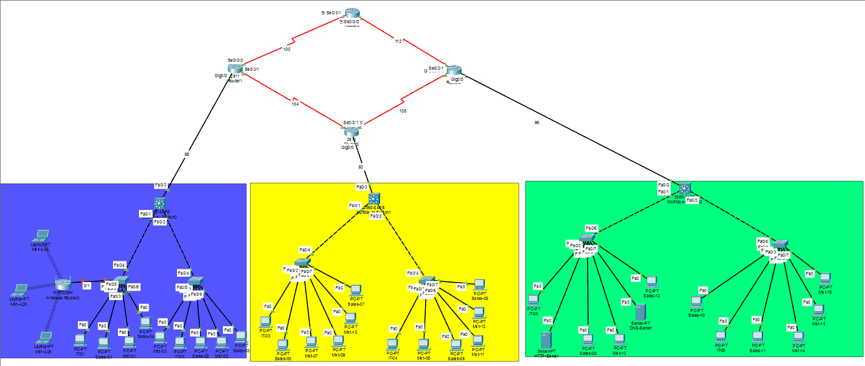
Designed and built a three-tier enterprise WAN for SkyGrid Networks Ltd across three branch sites — redundant OSPF core, VLSM addressing, VLAN segmentation, hardened devices and core services — then verified it end to end with ping and traceroute.
Overview
- Objective
- Design a network for SkyGrid Networks Ltd that links three branch sites, keeps each site's Marketing, Sales and IT traffic separated, and routes efficiently over redundant paths.
- Environment
- Cisco Packet Tracer
- My role
- Network designer & implementer
- Architecture
- Three-tier — core routers, distribution multilayer switches, access switches
- Sites
- Warsaw · London · York, each with Marketing, Sales and IT VLANs
- Addressing
- 210.165.10.0/24 subnetted with VLSM
Methodology
- 01
Addressing with VLSM
Split 210.165.10.0/24 into right-sized subnets so each department got only what it needed — for example, in London: Marketing a /28, Sales and IT a /29 each — leaving room to grow without renumbering.
- 02
Three-tier hierarchy
Built the network in core, distribution and access layers so each layer has one job and traffic stays close to its source.
- 03
VLAN segmentation & inter-VLAN routing
Placed Marketing, Sales and IT in separate VLANs at each site, with the distribution multilayer switches acting as their gateways and routing between them.
- 04
OSPF WAN core
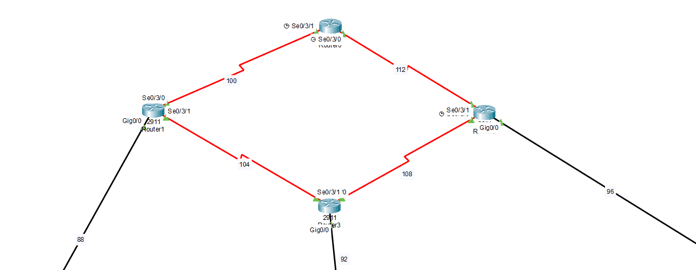
Linked the sites with serial WAN lines between the core routers and ran OSPF (area 0) so paths are learned automatically and re-converge over the redundant links if one fails.
- 05
Security hardening
Configured an encrypted enable secret, console and VTY passwords, SSH access (domain name, 1024-bit RSA key pair and a local account) to replace Telnet, and a Message-of-the-Day warning banner.
- 06
Services
Added DNS, an HTTP web server and wireless coverage so the network supports real-world services, not just host-to-host reachability.
Evidence
Testing & verification
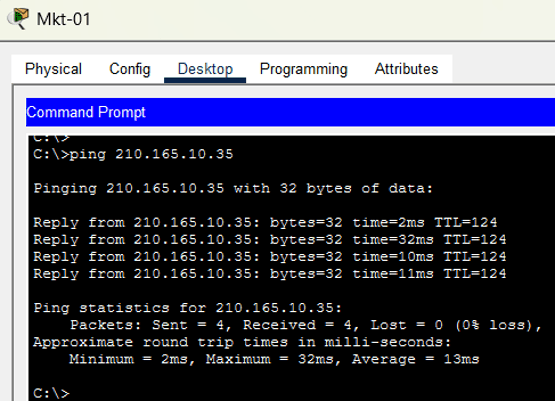
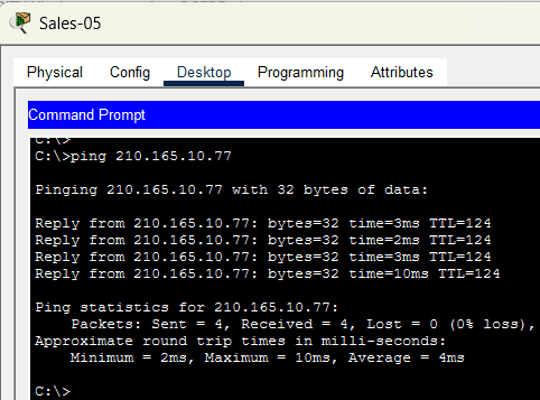
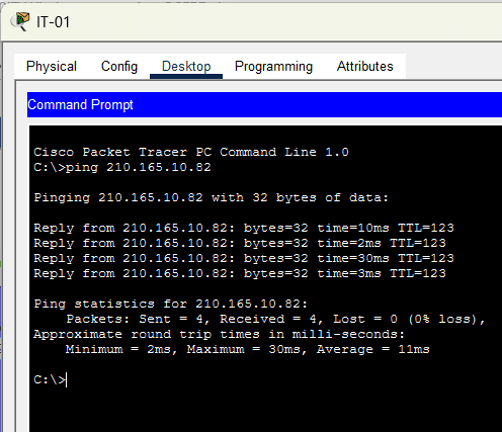
- Every ping test returned all four replies with 0% loss — where the first packet dropped, ARP resolution explained the one-off delay before traffic settled.
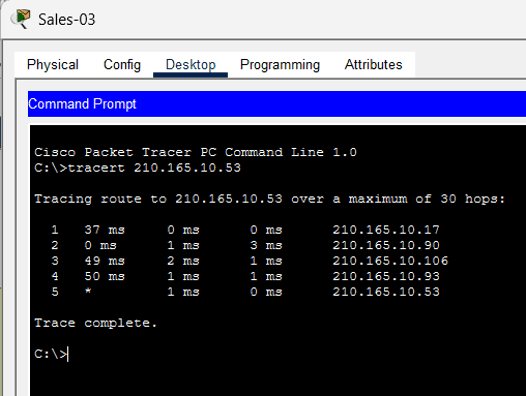
- Traceroute showed a single hop for same-subnet traffic and multiple hops between sites, matching the OSPF-computed paths.
- Both local switching and inter-VLAN routing were confirmed — traffic stayed within a VLAN where it should, and crossed the core only when it had to.
Troubleshooting
- Wireless clients lost connectivity and pings timed out; switch port Fa0/5 to the wireless router sat down/down.
- The cable was in the wireless router's Internet (WAN) port — moving it to a plain Ethernet port and running 'no shutdown' brought the link up/up and restored reach.
- A pass over each end device's IP, mask and default gateway cleared the remaining VLAN and inter-site conflicts.
Reliability & resilience
- OSPF senses a failed link and re-routes automatically, with no manual intervention.
- The redundant serial links mean losing one backbone link doesn't isolate a site.
- The three-tier hierarchy isolates faults — a broken access switch or VLAN affects only its own users, not the whole network.
What I learned
- Segmentation is a security control, not just a tidy diagram.
- A VLSM plan drawn up front makes routing, services and troubleshooting all easier later.
- Most 'network' faults come down to the physical layer and a wrong gateway — check those first.
Next project
Orvexa Labs